

One of the more unexpected aspects of my first six months as a councillor has been the amount of time spent learning about governance and accountability frameworks rather than dealing with matters concerning roads, rates and rubbish.
Are Councillor behavioural standards being used for the purpose they were designed to serve?
Recent experiences have led me to examine South Australia's behavioural standards framework in far greater detail than I ever expected.
South Australia’s Behavioural Standards for Council Members were introduced with a sensible objective. Communities rightly expect elected representatives to treat one another with respect, act professionally and avoid behaviour that undermines effective governance.
Few would argue against standards intended to address bullying, harassment, intimidation, discrimination or conduct that damages working relationships within a council.
Indeed, strong behavioural standards are an important part of maintaining public confidence in local government.
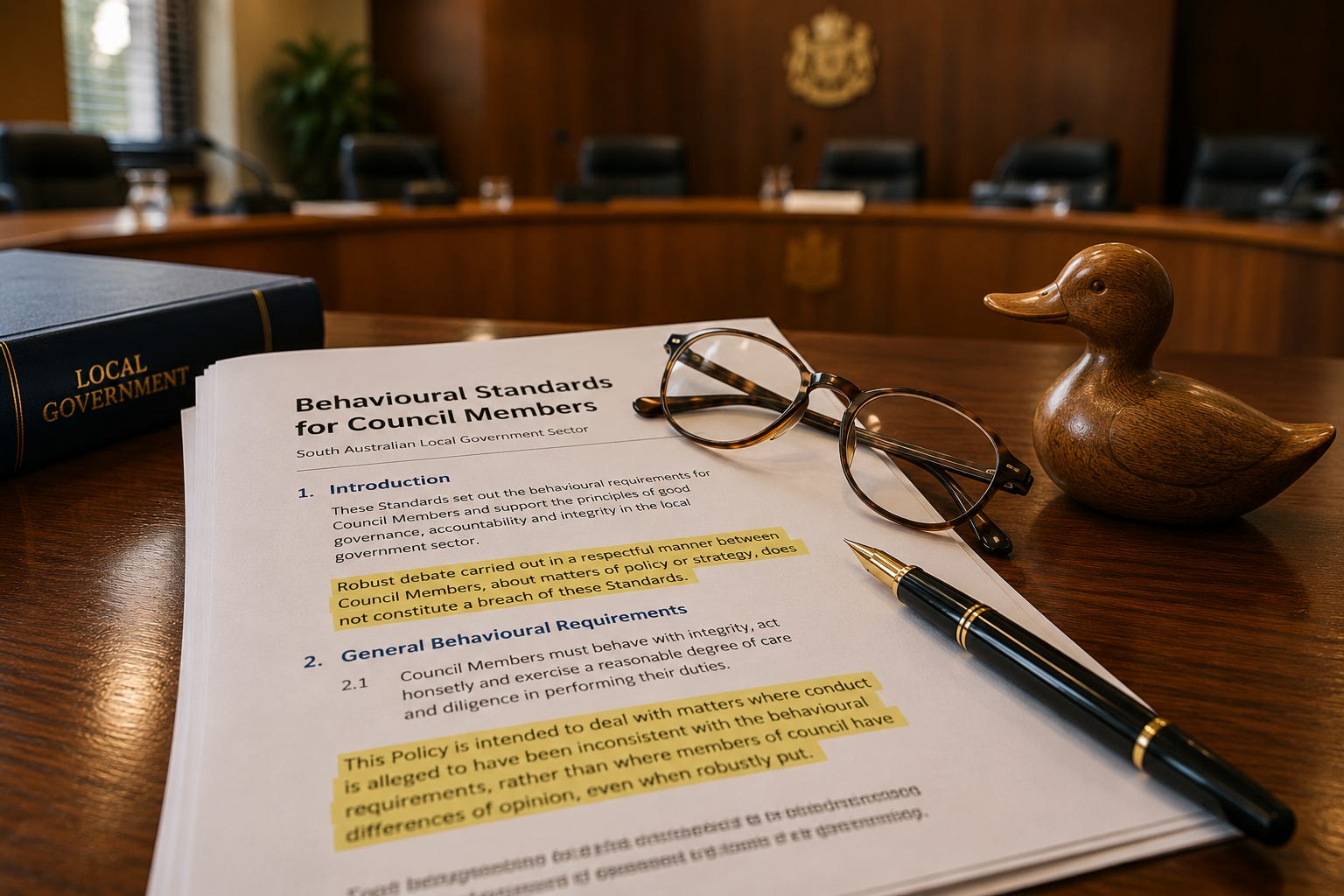
However, while reading both the Behavioural Standards for Council Members and Mount Barker District Council’s Behavioural Management Policy, I was struck by two important passages.
The first appears in the Behavioural Standards themselves, which explicitly states the following situation does not constitute a breach.
“robust debate carried out in a respectful manner between Council Members”
The second appears in Council’s Behavioural Management Policy, which states:
“This Policy is intended to deal with matters where conduct is alleged to have been inconsistent with the behavioural requirements, rather than where members of council have differences of opinion, even when robustly put.”
Those statements appear straightforward.
Local government is a democratic institution. Councillors are elected to represent different views, priorities and philosophies of the community and in this context
Disagreement is not merely inevitable; it is an essential feature of representative democracy.
Councillors should disagree.
They should challenge one another’s ideas.
They should question decisions.
They should debate priorities.
They should scrutinise leadership.
They should argue over policy, advocacy and outcomes.
Provided those discussions occur respectfully, robust political debate is not a failure of democracy. It is democracy functioning as intended.
Constructive dissent is not a weakness of representative democracy.
It is one of its strengths.
The Distinction Between Conduct and Politics
This raises an important question.
Where should the line be drawn between behavioural misconduct and political disagreement?
Consider a range of statements that may be made in political debate:
A Mayor has failed to advocate strongly enough for the community.
A councillor has prioritised the wrong issues.
Council leadership has been ineffective.
Insufficient infrastructure outcomes have been achieved.
The community deserves stronger representation.
A political spokesperson has become ineffective in dealing with another level of government.
Reasonable people may disagree with such statements and they may even consider them unfair. But are they behavioural matters?
Or are they political arguments that should be tested through evidence, debate, public scrutiny and ultimately elections?
There is an important distinction between saying someone is wrong and saying someone has behaved improperly.
One invites discussion, whereas the other invokes a compliance framework.
In my view, behavioural standards are at their strongest when they focus on conduct rather than political judgement.
The more behavioural processes become involved in determining questions of political performance, advocacy or effectiveness, the greater the risk that the distinction between misconduct and disagreement becomes blurred.
That outcome serves nobody well, but particularly disadvantages the community.
The Complaint Process Itself
One aspect of the behavioural framework that receives relatively little public attention is the process itself.
A behavioural complaint is not simply a disagreement between two elected members.
It initiates a formal process that may require written responses, meetings, investigations, mediation, legal advice and significant commitments of time and resources.
Even where no breach is ultimately found, the councillor responding to the complaint may still be required to invest substantial time and effort defending their position.
This creates an important governance question.
Should behavioural complaint mechanisms primarily exist to address misconduct?
Or should they also be used to resolve disagreements about political opinions, political advocacy, leadership effectiveness or policy outcomes?
The distinction matters because complaint processes are not cost free.
They consume resources.
They consume time.
They consume attention.
Most importantly, they divert focus away from the work councillors were elected to perform on behalf of their communities.
There is a further concern where complaints are ultimately dismissed or found not to involve misconduct. In such circumstances, the burden imposed by the process itself may significantly exceed any eventual outcome.
The time required to prepare responses, review evidence, participate in meetings and navigate procedural requirements can be substantial. Even where no breach is established, those costs have already been incurred.
This creates a risk that the process itself becomes punitive in practice, regardless of whether that was the intention of the complainant or the framework.
The process itself becomes the punishment.
In governance systems, sanctions are intended to follow findings of misconduct. Where substantial burdens are imposed before any finding is reached, there is a risk that the practical impact of the process exceeds the significance of the outcome.
Confidentiality and Chilling Speech
Confidentiality forms part of the behavioural complaint framework, and in many cases there are sound reasons for this.
Confidentiality protects procedural fairness.
It protects complainants.
It protects respondents.
It prevents unnecessary reputational harm while allegations are being assessed.
However, confidentiality can also create unintended consequences.
When a complaint is dismissed, the public often has little visibility of the process or the reasoning behind the outcome.
When a matter is determined to be a political disagreement rather than misconduct, that distinction may never become widely known.
The public may hear allegations, but never hear the resolution.
In some circumstances, the process itself can become more significant than the outcome.
That is not necessarily the result of bad faith by any individual participant. Rather, it is a consequence of how confidential complaint systems operate.
There is also a broader democratic consideration.
Behavioural complaints are not without cost. Even where a complaint is ultimately dismissed, the councillor responding to the complaint may be required to spend considerable time preparing responses, gathering evidence, seeking advice and participating in the process.
Most elected members are not professional politicians. They are volunteers or part-time representatives balancing council duties alongside employment, business and family commitments.
When political criticism or disagreement becomes the subject of formal complaint processes, it is reasonable to ask what effect that may have on future debate.
Some councillors may become less willing to publicly challenge decisions.
Some may become less willing to criticise leadership.
Others may avoid expressing views on contentious matters altogether.
Not because they lack confidence in their own views, but because they wish to avoid the burden, uncertainty and stress associated with formal behavioural complaints.
This can bring a chilling effect to speech from within the elected body.
No democratic institution benefits when elected representatives become reluctant to speak openly about matters of public interest.
The purpose of behavioural standards should be to discourage misconduct.
It should not be to discourage scrutiny.
It should not be to discourage criticism.
And it should not be to discourage political disagreement.
If councillors begin self-censoring out of concern that robust political commentary may trigger behavioural complaints, the community ultimately loses an important part of democratic accountability.
The challenge for any behavioural framework is ensuring it protects respectful conduct without creating incentives for elected representatives to remain silent.
The issue is not whether Elected Members feel comfortable.
Public scrutiny is rarely comfortable.
The real issue is whether communities continue to receive frank, honest and independent representation from those they elect.
If complaint processes discourage elected members from expressing legitimate opinions, it is ultimately the public that loses.
Democracy Requires Robust Debate
Local government works best when elected representatives are prepared to speak openly about matters affecting their communities.
Councillors should feel able to question decisions.
They should feel able to challenge leadership.
They should feel able to criticise advocacy efforts.
They should feel able to express differing views on policy and strategy.
That does not mean councillors should be free to bully, harass, intimidate or deliberately mislead. Those behaviours should rightly attract consequences.
But there are significant differences between:
misconduct and criticism.
personal attacks and political scrutiny.
harassment and accountability.
If elected members become reluctant to express strongly held views because of concern that political disagreement may trigger behavioural complaints, the community ultimately loses something valuable.
Healthy democratic institutions depend upon scrutiny.
They depend upon accountability.
They depend upon robust discussion.
And sometimes they depend upon uncomfortable questions being asked.
The public is generally best served when political disagreements are resolved through debate, evidence and public scrutiny rather than behavioural complaint mechanisms.
Are We Focusing on the Right Accountability Mechanisms?
Recent experiences have also led me to consider a broader question.
Local government contains multiple accountability frameworks.
Behavioural standards deal with conduct.
Integrity provisions deal with conflicts of interest, governance failures and misuse of office.
Meeting procedures govern how decisions are made.
Elections allow the community to judge performance.
Each framework exists for a different reason.
The challenge is ensuring each framework remains focused on the purpose for which it was created.
When political disagreements are treated as behavioural issues, there is a risk that genuinely important governance and accountability questions receive less attention than they deserve.
The public interest is best served when concerns about conduct are addressed through conduct frameworks, concerns about integrity are addressed through integrity frameworks, and political disagreements are resolved through democratic debate.

Possible Areas for Reform
As South Australia continues to review and reform local government legislation, this may be an area worthy of further consideration.
Questions that may deserve discussion include:
Should behavioural standards more clearly distinguish between misconduct and political disagreement?
Should there be an early dismissal process for complaints that primarily concern political opinions or assessments of performance?
Should greater public transparency be provided when complaints deal with differences of political opinion rather than allegations of misconduct?
Should de-identified reporting of complaint outcomes be expanded to improve public understanding of the system?
Should councillor training place greater emphasis on the distinction between conduct issues and democratic debate?
Are existing governance frameworks sufficiently protecting robust political discussion while still addressing genuine misconduct?
None of these questions seek to weaken behavioural standards. Rather, they seek to ensure those standards remain focused on the purpose for which they were created.
Reasonable people may disagree on the answers.
What should concern us all, however, is if councillors become hesitant to engage in legitimate political debate because they fear formal complaint processes more than political disagreement itself.
Final Reflections
A healthy local government depends on more than good behaviour alone.
It also depends on the willingness of elected representatives to challenge ideas, question decisions, scrutinise leadership and advocate passionately for their communities.
Democracy is not always comfortable.
Nor should it be.
The challenge for any behavioural framework is ensuring it protects respectful conduct without discouraging the robust political debate that representative democracy requires.
This may be one of the most important local government conversations we are yet to have.
A Broader Conversation
Since first publishing this article, I’ve become aware of the independent review of South Australia’s local government behavioural management framework undertaken by researchers from Flinders University.
While the review examines council culture more broadly than the issues discussed here, I was struck by how many of its observations align with the questions raised in this article.
Among other things, the review identifies concerns relating to psychological safety, confidence in behavioural complaint processes, the potential for complaints to be weaponised, and the need for clearer, more proportionate and more independent mechanisms for resolving disputes.
Whether or not readers agree with my conclusions, I think the alignment is noteworthy. It suggests these questions extend beyond any individual council or complaint and form part of a broader conversation about how local government can protect respectful conduct while also encouraging robust democratic debate and accountability.
For those interested in exploring the issue further, I encourage reading the Flinders University review that has been published on the LGA SA website alongside this article.
Signal Boost
Should behavioural standards regulate conduct, political disagreement, or both?
I'd be interested to hear how others think local government can protect respectful behaviour without discouraging scrutiny, dissent and democratic debate.