

In any healthy democracy, altering the democratic timetable
should carry a high burden of proof.
The South Australian Parliament has now passed legislation postponing the 2026 local government elections until April 2027.
Whether you agree with that decision is almost beside the point. The legislation has passed, and the election will now be held five months later than originally scheduled.
The more important question is this:
Was the public ever given a sufficiently compelling reason for making such an extraordinary change?
Changing an election date is not simply an administrative decision. It extends the democratic mandate of every council in South Australia beyond the term voters expected when they cast their ballots in 2022.
That should never be regarded as an ordinary administrative decision.
In any healthy democracy, altering the timing of an election should require more than administrative convenience or broad assurances that it is necessary. It should require a clear, evidence-based explanation that demonstrates why the normal democratic process cannot proceed.
That is the question I believe remains unanswered.
Had ECSA demonstrated that a free and fair local government election simply could not be conducted in November, postponement may well have been justified. My concern is not that Parliament reached the wrong conclusion, but that the evidence supporting such an exceptional conclusion was never clearly presented to the public.

What Made 2026 Different?
Every election presents challenges. Staffing issues arise. Administrative errors occur. Processes are reviewed and improvements are made. That is not unique to 2026.
The question is not whether problems occurred. The question is whether they met the burden of proof required to justify altering the democratic timetable.
South Australia has conducted local government elections for decades.
What appears to have changed is not the existence of electoral challenges, but Parliament's willingness to alter the democratic timetable in response.
Rather than addressing the identified issues while maintaining the existing democratic timetable, Parliament chose to postpone every local government election in South Australia and extend the term of every elected council by five months.
That is not a routine administrative decision. It is a significant change to the democratic timetable.
Which raises an obvious question:
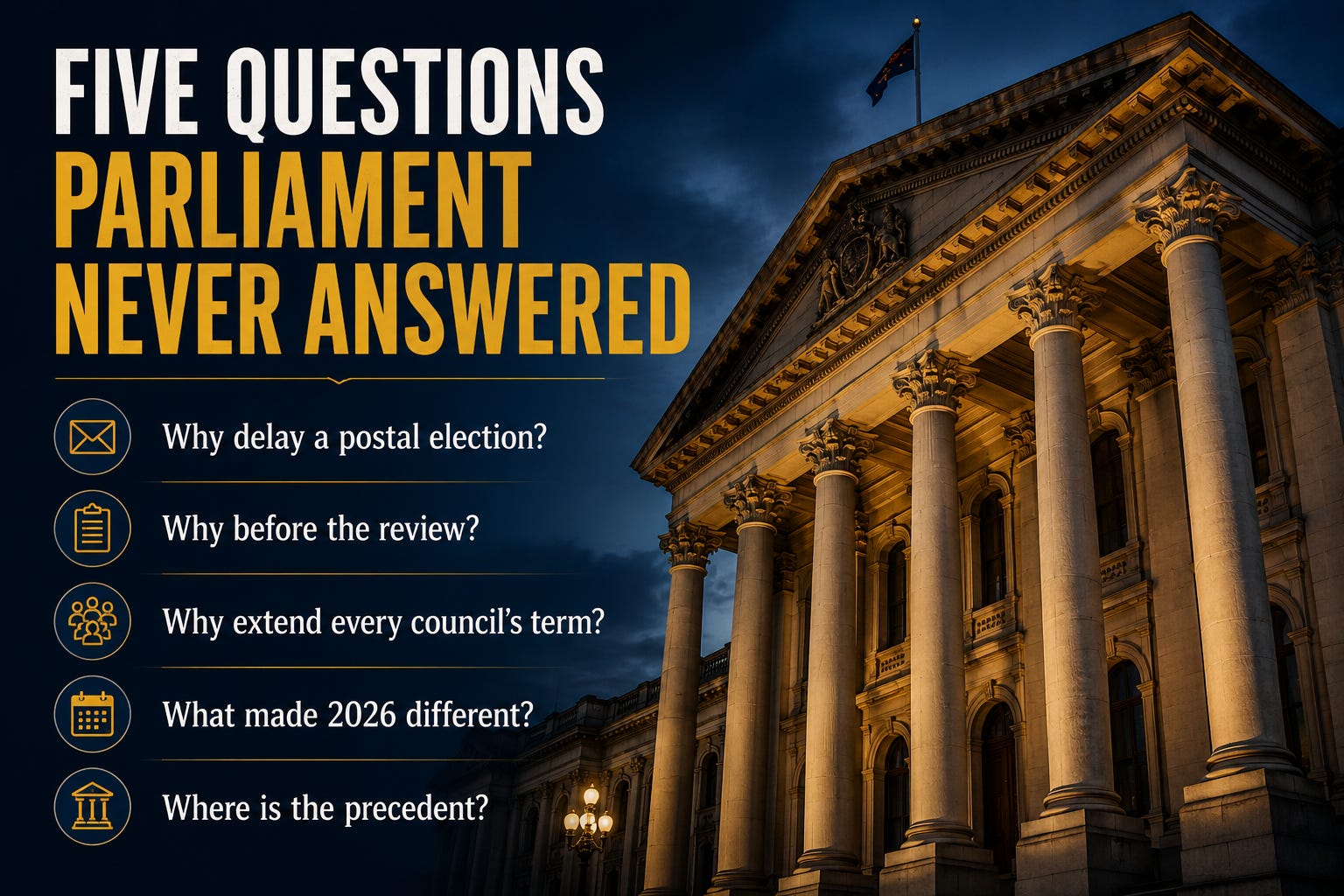
What made the circumstances surrounding the 2026 elections so exceptional that Parliament considered it necessary to depart from the established electoral cycle?
During the parliamentary debate, concerns were raised about polling booth staffing, misplaced ballot papers and computer system issues experienced during the State Election. Those concerns should be taken seriously.
But did those issues justify postponing an entirely separate election?
If so, the public deserves to understand why.
If not, then it is equally reasonable to ask why South Australia has, for what appears to be the first time, legislated to extend the democratic mandate of every local council after voters had already elected them.
Democracy should adapt when circumstances genuinely demand it. But changing the timing of elections should remain an exceptional measure, not one accepted simply because it appears administratively convenient.
Are State and Council Elections Really Comparable?
The primary justification for postponing local government elections was the operational difficulties experienced during the March State Election.
At first glance, that may seem reasonable.
But the more closely you examine the two electoral processes, the less obvious the connection becomes.
State elections rely on hundreds of polling booths operating simultaneously across South Australia. They require thousands of temporary staff to manage polling places, issue ballot papers, supervise voting and count votes under significant time pressure.
Local government elections are different.
They are voluntary postal elections.
There are no polling booths to staff.
Voting occurs over several weeks rather than a single day
The logistical and administrative processes are considerably simpler.
Those differences are significant.
If the problems identified by the Electoral Commission related primarily to polling booth operations and election day logistics, it is reasonable to ask why those issues automatically justified postponing a predominantly postal election held six months later.
The Electoral Commission's primary role is to administer elections. If it concluded that even a postal local government election could not proceed as scheduled, the public deserves a detailed explanation of the specific operational barriers that made postponement necessary.
To date, that explanation has not been clearly presented to the public.
Without a clear explanation of why a postal council election could not proceed, it is difficult to conclude that the burden of proof has been met.
Why Legislate Before the Review?
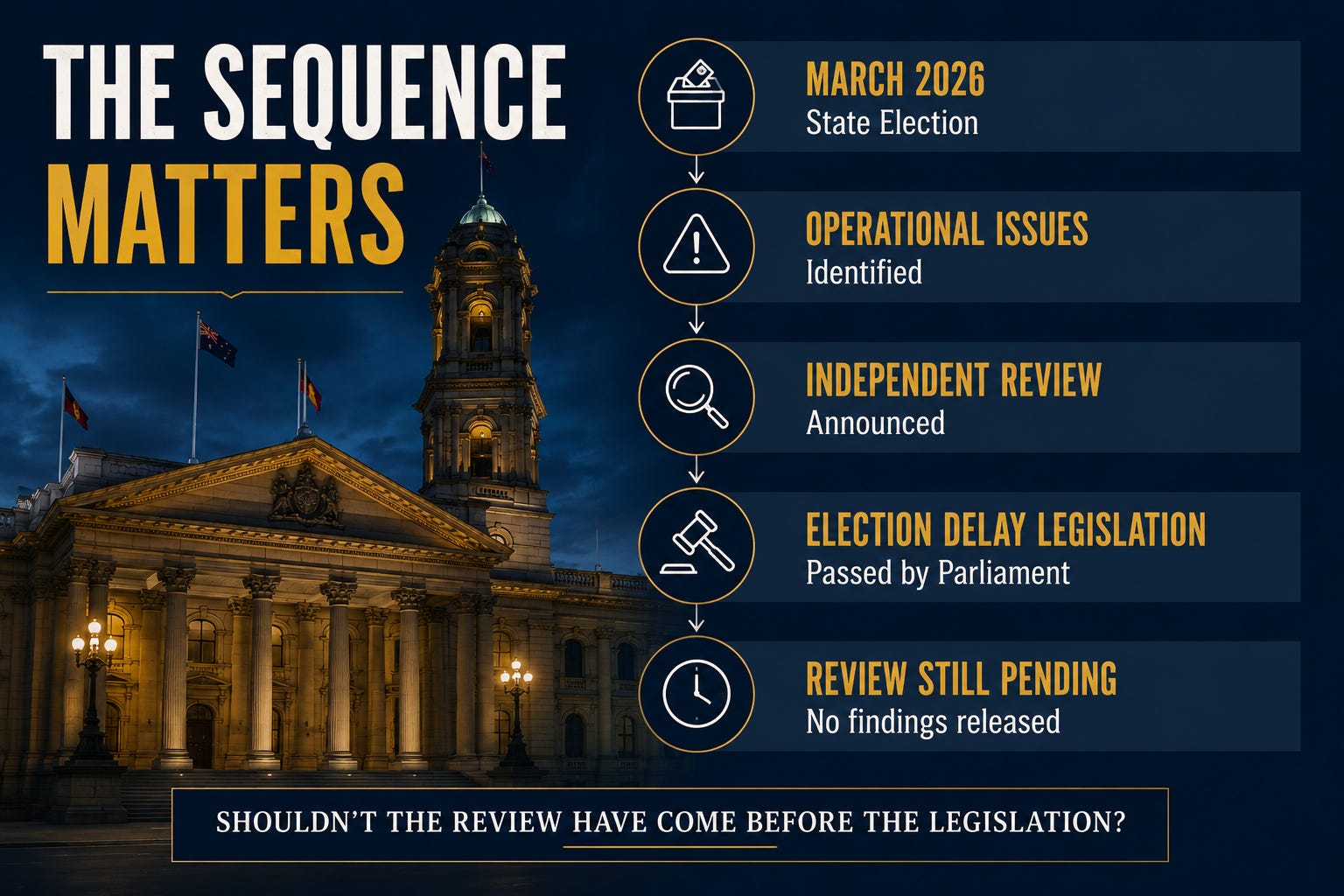
Following the operational issues experienced during the March State Election, the Government commissioned an independent review into the conduct of the election.
That was an appropriate step.
Independent reviews exist for a reason. They examine what occurred, identify contributing factors and recommend improvements before governments determine how best to respond.
Yet, before that review has even been released, Parliament has already enacted legislation postponing every local government election in South Australia.
That sequence is difficult to reconcile.
If the independent review has not yet reported, on what evidence was Parliament satisfied that delaying local government elections was necessary?
Did the Government already possess sufficient information to justify extending the democratic mandate of every council?
If so, why commission an independent review at all?
Alternatively, if the review is expected to provide the evidence needed to justify such a significant decision, why was Parliament asked to legislate before receiving its findings?
Until those questions are answered, it is difficult to see how Parliament could properly assess whether the burden of proof had been satisfied.
Changing electoral legislation before the completion of the very review established to examine the underlying problem creates the impression that the remedy was determined before the diagnosis was complete.
When an issue concerns the democratic timetable itself,
it’s a sequence worth questioning.
A Question of Precedent
Ultimately, Parliament itself was divided with the bill passing by a narrow margin.
✅ Supported the legislation
Labor
The Greens
Independent MLC Sarah Game
❌ Opposed the legislation
Liberal Party
One Nation
The more enduring question, however, is one less concerned with who voted for or against the legislation. It is whether Parliament was presented with a sufficiently compelling case to justify extending the democratic mandate of every local council in South Australia.
Election laws change from time to time. Boundaries are redrawn. Voting systems evolve. Disclosure requirements are updated. Those changes typically apply to future elections before voters cast their ballots.
Extending the term of elected representatives after they have already been elected is a different proposition altogether.
It changes the democratic timetable itself.
South Australia has, on occasion, delayed elections affecting individual councils.
What appears to be without precedent is Parliament postponing the scheduled elections for virtually every council across the State and extending the democratic mandate of every elected council.
If that understanding is correct, Parliament should have clearly explained what made 2026 so exceptional.
Instead, much of the discussion focused on administrative challenges rather than the broader democratic principle.
That is why the questions raised in this article matter.
Conclusion
This is not about whether the election should have been held in November or April. Nor is it about the political parties that ultimately supported or opposed the legislation.
Democracy occasionally requires exceptional decisions.
But exceptional decisions carry an equally exceptional burden of proof.
South Australians may ultimately agree that postponing the election was justified.
The question raised in this article is whether Parliament demonstrated that justification before asking South Australians to accept such an exceptional change.